
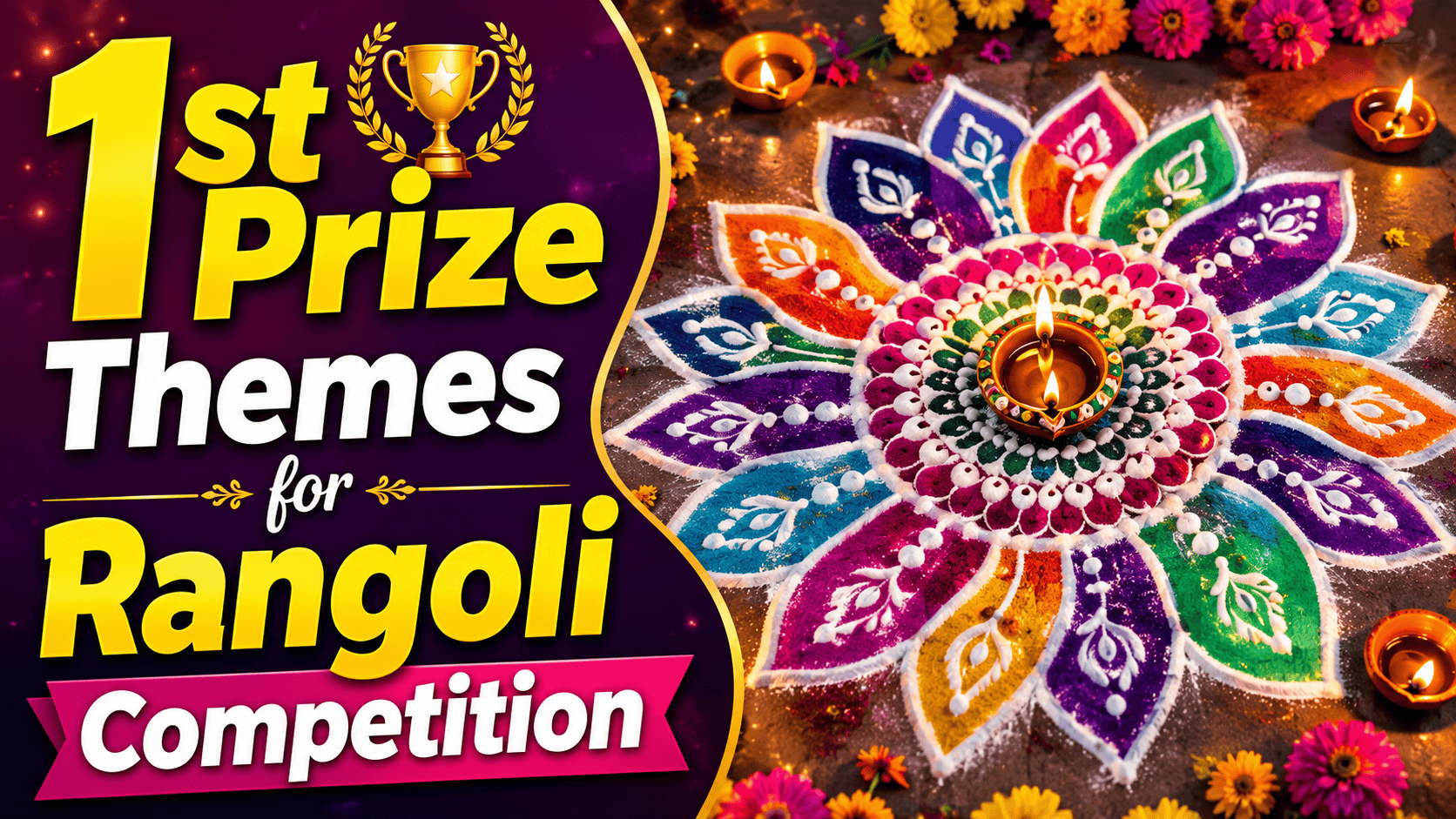
Choosing the right theme is often the first and most important step when preparing for a Rangoli competition. A beautiful Rangoli begins with good colours and careful execution, but a clear theme gives the entire design a purpose. It helps participants decide what to draw, which colours to use and how to arrange the design within the available space.
Themes for Rangoli competition can range from traditional Indian motifs and flowers to nature, festivals, cultural heritage, social messages and creative contemporary concepts. The best theme is not necessarily the most complicated one. It is an idea that can be understood visually, developed creatively and completed confidently within the competition’s time and space.
For students, teachers, office teams and families, a Rangoli competition can also become much more than an artistic contest. It can be an opportunity to explore Indian culture, work together, experiment with colour and make a festival celebration more memorable.
This guide brings together creative, traditional and easy themes for Rangoli competition, along with practical ideas for choosing and developing your own design.
How to Choose a Theme for a Rangoli Competition
Before deciding on a theme, look at the competition requirements.
The available space, time limit, number of participants and permitted materials can all influence your choice. A highly detailed theme may look impressive on a large floor but become difficult to complete when the competition gives you only an hour.
Think about the audience as well. A school competition may benefit from a cultural or environmental theme, while an office competition could use a theme related to teamwork, diversity or sustainability.
Most importantly, choose one central idea.
A Rangoli becomes easier to design when every major element supports the same theme. Instead of trying to include flowers, peacocks, monuments, dancers and festival symbols together, choose one main story and build around it.
20 Themes for Rangoli Competition
1. Floral Theme
Flowers are among the easiest subjects to adapt into a Rangoli competition theme.
You can create a large central lotus, a circular arrangement of flowers or a garden-inspired composition. Different petals can provide natural opportunities for colour variation, while leaves and geometric borders can complete the design.
A floral theme is especially suitable for beginners because the basic shapes are familiar and can be simplified or expanded depending on the available time.
For a more distinctive competition design, instead of drawing many unrelated flowers, choose one flower as the main subject and develop the entire Rangoli around it.
2. Peacock Theme
A peacock is a classic Indian artistic motif and one of the most visually flexible themes for Rangoli competition.
The feathers provide an opportunity to experiment with colour, symmetry and repeating patterns. You can create a single large peacock as the centrepiece or use two peacocks facing each other.
Blue, green and contrasting shades can help define the feathers, while smaller decorative patterns can fill the surrounding space.
The main challenge is maintaining a clear focal point. Avoid filling the entire design with tiny details that make the peacock difficult to recognise.
3. Lotus Theme
The lotus is another strong choice for a traditional Rangoli competition.
Its symmetrical shape works naturally with circular compositions and Mandala-inspired designs. You can create several layers of petals and surround the lotus with smaller patterns, diyas or floral elements.
A lotus theme can also be adapted to different skill levels. Beginners can use simple geometric petals, while experienced participants can introduce shading, layered colours and more detailed borders.
4. Festival Theme
A festival theme allows the Rangoli to connect directly with the occasion.
For Diwali, you might use diyas, lamps, flowers and traditional motifs. For Navratri, you could draw inspiration from Garba, traditional clothing, festive colours or devotional elements.
The important thing is to create a unified composition rather than placing several festival symbols randomly across the floor.
A central diya surrounded by flowers and decorative patterns, for example, can communicate a festival theme more effectively than a crowded collection of unrelated objects.
You can explore more ideas through IndianFestival101’s festival decoration guides.
5. Indian Culture Theme
Indian culture provides an enormous range of inspiration for Rangoli competition themes.
Traditional clothing, folk art, musical instruments, dance, architecture and regional motifs can all be incorporated into a single composition.
A particularly interesting approach is to select one cultural element and make it the central focus. You could then use surrounding patterns to represent different parts of India.
This gives the Rangoli both artistic and educational value.
6. Indian Heritage Theme
India’s monuments and historical heritage can become the foundation for a memorable Rangoli.
A monument can be simplified into an outline and placed at the centre, with traditional patterns or regional elements surrounding it.
Instead of attempting to reproduce every architectural detail, focus on the distinctive shape that makes the monument recognisable.
A heritage theme is particularly suitable for school and cultural competitions because the design can communicate both creativity and an appreciation of India’s history.
7. Mandala Theme
A Mandala-inspired Rangoli is ideal when symmetry and precision are central to the competition.
Begin with a central point and develop the design outward through repeated circles, petals, geometric shapes and decorative patterns.
The strength of this theme lies in balance. Each section should complement the others, creating a sense of visual harmony.
If time is limited, use fewer layers with larger patterns rather than trying to create excessive detail.
8. Nature Theme
Nature provides countless possibilities for Rangoli competition themes.
Trees, flowers, butterflies, birds, mountains, rivers and other natural elements can be combined into a composition celebrating the environment.
A nature theme can be made simple or elaborate depending on the participants’ experience.
For example, beginners might create a large tree surrounded by flowers and birds, while advanced participants could develop an entire landscape.
9. Environmental Awareness Theme
A Rangoli can communicate a message as well as create a beautiful visual display.
Environmental themes can focus on tree planting, clean surroundings, water conservation, biodiversity or reducing waste.
The message should be easy to understand from a distance. A central tree, water drop or Earth can provide a clear visual focus, while supporting elements reinforce the idea.
This is particularly useful for school competitions where artistic activities can also support environmental education.
10. Unity in Diversity Theme
“Unity in Diversity” is a natural subject for an Indian cultural Rangoli.
The design can bring together different regional patterns, traditional clothing, dance forms, monuments or cultural symbols.
Instead of dividing the Rangoli into unrelated sections, look for a visual element that connects everything. A circular design can work particularly well because different elements can come together around a shared centre.
This theme can also work effectively for corporate and community competitions.
11. Indian Dance Theme
India’s many dance traditions provide excellent visual inspiration.
A Rangoli can feature dancers, traditional costumes, musical instruments or rhythmic patterns.
Rather than trying to reproduce a highly detailed human figure, use a recognisable silhouette and let the surrounding patterns communicate movement.
The result can feel energetic while remaining manageable within a competition setting.
For a festival event, a Garba-inspired dance theme can create an especially strong connection between the artwork and the celebration.
12. Indian Musical Instruments Theme
Musical instruments can create an unusual alternative to more common floral and geometric designs.
A central instrument can be surrounded by musical notes, decorative patterns or silhouettes of performers.
The theme works particularly well for school cultural events and competitions connected to music or traditional performances.
Choose one or two recognisable instruments instead of trying to represent every instrument in Indian music.
13. Mythology and Storytelling Theme
A mythology-inspired Rangoli can turn the artwork into a visual story.
Instead of attempting to represent an entire epic or legend, select one recognisable scene, character or symbolic moment.
The central image should remain clear, while the surrounding elements support the story.
This theme can be particularly engaging for school competitions because participants can research the story before designing the Rangoli and explain its meaning afterwards.
14. Women Empowerment Theme
A social-message Rangoli can focus on women’s education, leadership, independence, achievements and opportunities.
A strong central figure can be surrounded by symbols such as books, careers, education, creativity or community.
Avoid putting too much written text into the design. Rangoli communicates most effectively through visual storytelling.
This theme can work especially well for school, college and workplace events with a social-awareness component.
15. Peace and Harmony Theme
Peace and harmony can be expressed through simple symbols such as joined hands, birds, flowers, a globe or people coming together.
A circular composition can reinforce the idea of connection and unity.
Because the message is relatively broad, colour and composition become particularly important. Keep the central idea simple enough that viewers can understand it without needing a long explanation.
16. Rural India Theme
A Rural India theme can tell a story through everyday life.
You could represent village homes, farms, trees, traditional occupations, folk musicians or community celebrations.
The challenge is deciding what to leave out.
Trying to depict an entire village can make the design crowded. Select two or three elements that communicate the rural setting and give them enough space to remain visually clear.
17. Wildlife Theme
Wildlife can create a colourful and educational Rangoli.
Participants can choose a particular animal or ecosystem and build the design around it. A tiger, elephant, peacock, butterfly or group of birds can become the central subject.
A wildlife theme can also be connected to conservation, creating a stronger message for school competitions.
18. Seasons of India Theme
The changing seasons offer a creative way to divide a Rangoli into visual sections.
Spring can be represented through flowers, monsoon through clouds and rain, summer through sunlight and nature, while winter can use cooler visual elements.
Alternatively, focus on one season and create a detailed composition around it.
This theme encourages participants to think about colour as well as storytelling.
19. Space and Universe Theme
A cosmic Rangoli can create a dramatic competition design.
Planets, stars, galaxies and constellations can be arranged around a central celestial element. Circular patterns naturally work with the subject.
Contrasting colours can make the planets and stars stand out.
However, avoid scattering too many objects across the design. Give the composition a clear centre so that viewers know where to look first.
20. Travel Across India Theme
A “Travel Across India” theme is ideal for a Rangoli that celebrates India’s geographical and cultural diversity.
The design could bring together landscapes, monuments, traditional arts, festivals and regional symbols.
You do not need to represent every state. Select a few distinctive elements and connect them through a single visual composition.
For example, mountains could transition into a historic monument, followed by a traditional dance and a festival scene.
This makes the Rangoli feel like a visual journey through India.
Easy Themes for Rangoli Competition
If the competition has a short time limit, choose a theme with simple, recognisable shapes.
Floral designs, lotus patterns, Mandalas, diyas, peacocks and simple nature compositions are often easier to adapt than highly detailed storytelling scenes.
The secret is to simplify rather than abandon creativity.
A large flower with carefully planned colour sections can be more effective than a complicated design that remains unfinished.
Themes for Rangoli Competition in Schools
School competitions offer an opportunity to combine creativity with learning.
Themes such as Indian culture, heritage, nature, environmental awareness, unity in diversity, seasons and mythology can encourage students to research the subject before creating their design.
Teachers can make the activity even more meaningful by asking students to explain the idea behind their Rangoli after the competition.
This transforms the activity from simply making a decorative pattern into a cultural and educational experience.
Themes for Rangoli Competition in Offices
For offices, themes can be slightly more contemporary.
Unity, teamwork, diversity, sustainability, Indian culture and festival celebrations can all work well.
A team-based Rangoli can also encourage employees to divide responsibilities between sketching, outlining, colouring and detailing.
The activity then becomes an opportunity for collaboration rather than an individual artistic exercise.
How to Make Your Rangoli Theme Stand Out
Once you have selected a theme, focus on execution.
Start with a rough sketch and decide where the central subject will sit. Then establish the major shapes before worrying about small details.
Use colour strategically. Too many competing colours can make the design difficult to read, while a limited palette can create stronger contrast.
Keep the borders clean and make sure the central subject is visible from a distance.
Most importantly, leave enough space around the main elements. Negative space can make a Rangoli look more organised and sophisticated.
Common Mistakes to Avoid
One of the most common mistakes is choosing a theme that is too complicated for the available time.
Another is trying to copy a reference image exactly. A reference can provide inspiration, but your final composition should be adapted to the space, materials and competition requirements.
Using too many colours is another common problem. Colour variety is attractive, but every colour should have a purpose.
Finally, do not add details simply to fill empty space. Empty space can actually improve the visual balance of the design.
Rangoli Materials for a Competition
The materials you use will depend on the competition rules.
Common options include coloured Rangoli powder, rice flour, flower petals, coloured rice and other decorative materials.
Some competitions may restrict synthetic colours, glitter, adhesives or additional decorative objects, so check the rules before preparing your design.
If you are organising a school or office competition, providing clear material guidelines beforehand can make the event easier for everyone.
Turn a Rangoli Competition Into a Festival Activity
Rangoli becomes even more engaging when it is part of a larger celebration.
At home, families can organise a small Rangoli activity alongside festive decoration, traditional food and music. Children can create smaller designs while adults work on a larger central Rangoli.
Schools can combine the competition with cultural storytelling, traditional dress, crafts and festival education.
Offices can include Rangoli as one activity within a wider festival celebration involving food, music, traditional clothing and team activities.
This is where a simple Rangoli competition can become part of the broader festival experience that IndianFestival101 is designed to help people create.
For more ideas, explore our Navratri Decoration Ideas and other festival activity resources.
Rangoli, Creativity and Indian Culture
Rangoli is temporary, but the experience of creating it can stay with people for much longer.
Children learn through colour and pattern. Families work together. Colleagues collaborate. Communities decorate shared spaces. Participants explore traditional Indian motifs while adding their own creativity.
That is why choosing a theme matters.
The theme gives the artwork a story, while the Rangoli provides the visual language.
Whether your competition calls for a traditional design, a social message, a festival theme or something completely original, start with one clear idea and develop it thoughtfully.
Frequently Asked Questions
What are the best themes for Rangoli competition?
Popular themes for Rangoli competition include flowers, peacocks, lotus designs, Indian culture, festivals, nature, environmental awareness, unity in diversity, mythology, heritage and social messages. The right theme depends on the competition’s rules, time, space and participants.
Which are easy themes for Rangoli competition?
Floral designs, lotus patterns, Mandalas, diyas, peacocks and simple nature themes can be adapted into easy Rangoli competition designs. Choose a concept that can be completed comfortably within the available time.
How do I choose a theme for Rangoli competition?
Consider the competition’s theme, available space, time limit, materials and participant skill level. Choose one clear concept that can be communicated visually and developed without overcrowding the Rangoli.
What are good Rangoli competition themes for schools?
Indian culture, Indian heritage, nature, environmental awareness, seasons, unity in diversity and mythology are useful themes for school competitions because they combine creativity with educational value.
How can I make my Rangoli competition theme unique?
Start with a familiar subject and give it your own composition, colour palette or storytelling approach. Instead of copying an existing design, simplify or combine visual elements in a way that reflects your own idea.
Let the Theme Tell the Story
A Rangoli competition does not begin with colour. It begins with an idea.
Choose a theme that you understand, that suits your space and that you can execute confidently. Then give the design a clear centre, thoughtful colours and enough space to breathe.
Whether you are creating a Rangoli for Diwali, Navratri, a school event, an office celebration or a community gathering, the artwork can become much more than a competition entry.
It can become a shared experience of creativity, culture and celebration.
Discover India. Celebrate Life.