
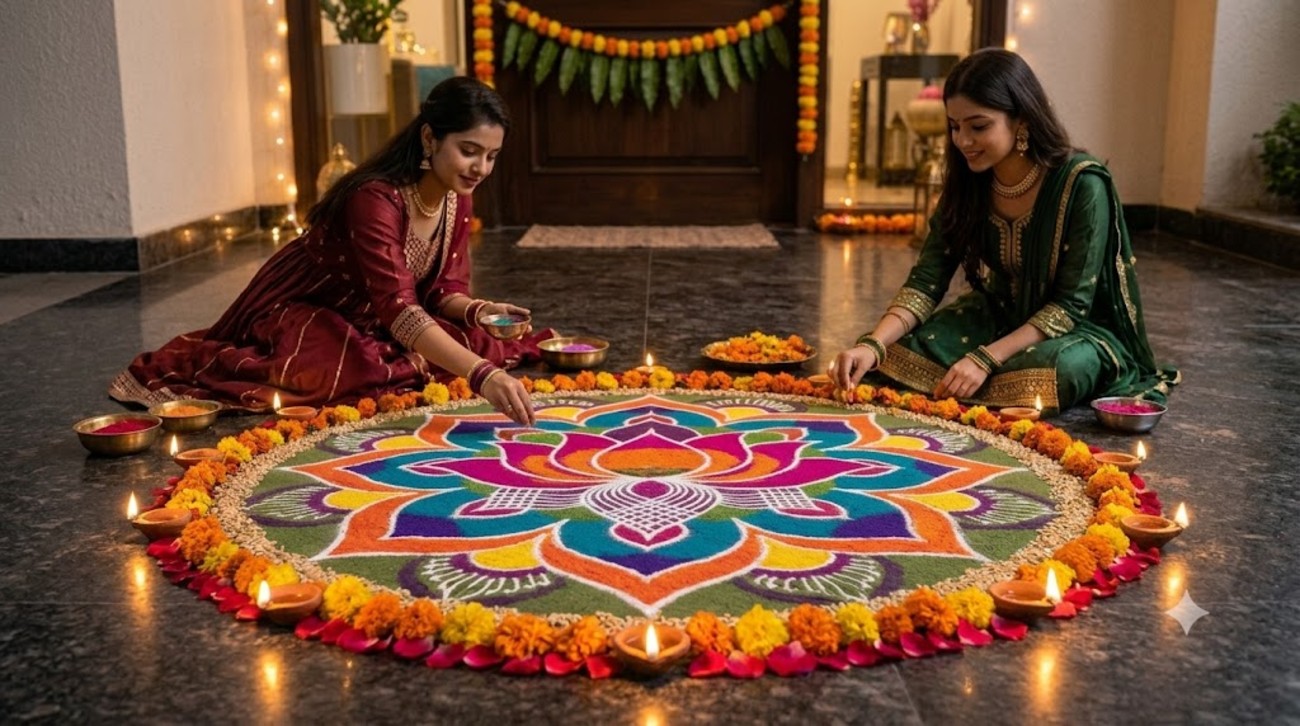
Diwali is a time when homes glow with diyas, doorways welcome guests, and colourful rangoli designs bring an extra touch of beauty to the celebrations. Whether you live in a spacious house, a small apartment, or a rented home, a thoughtfully chosen rangoli can make your entrance feel festive and welcoming.
The best rangoli design for Diwali does not have to be complicated. A simple flower pattern, a traditional lotus, a diya motif, or a geometric design made with a few bright colours can look beautiful when planned carefully. The key is to choose a pattern that suits your available space, materials, time, and artistic confidence.
In this guide, you will discover 25 rangoli design ideas for Diwali, from easy patterns for beginners to traditional Indian motifs, floral arrangements, and contemporary designs. You will also learn how to make a simple rangoli at home, which materials to use, and how to select a design for your doorway, living area, balcony, or festive gathering.
INDIANFESTIVAL101 COMMUNITY
Make Every Celebration Special
Get festival inspiration, cultural stories, celebration ideas and practical guides delivered to your inbox.
By subscribing, you agree to our Privacy Policy.
Why Is Rangoli Made During Diwali?
Rangoli is a traditional Indian art form created on floors, courtyards, entrances, and other welcoming spaces. During Diwali, families make rangoli to decorate their homes and create a festive atmosphere. In many households, the decorated entrance is also associated with welcoming guests, prosperity, and auspicious beginnings.
Rangoli styles vary across India. Designs may feature geometric patterns, lotus flowers, peacocks, footprints, lamps, or regional motifs. Some families draw patterns using rice flour or coloured powders, while others arrange fresh flowers, petals, or coloured rice.
There is no single design that every family must follow. The most meaningful rangoli is one that reflects your traditions, creativity, and way of celebrating Diwali.
25 Beautiful Rangoli Designs for Diwali
Use these ideas as inspiration and adapt the colours, size, and details to suit your home. Beginners can start with basic shapes and gradually add borders, dots, petals, or decorative accents.
Easy Rangoli Designs for Beginners
These designs are suitable if you are making rangoli for the first time or need a quick decoration before guests arrive.
1. Simple Circular Rangoli
A circular rangoli is one of the easiest patterns to create. Start with a small circle and build outward using coloured rings, dots, petals, or simple curves.
Choose three or four complementary colours, such as yellow, pink, green, and purple. Finish the outer edge with white dots for a neat, balanced appearance.
Best for: First-time rangoli makers, doorways, and small spaces.
Difficulty: Easy.
Materials: Rangoli powder, chalk or a pencil for marking, and a small spoon.
2. Four-Petal Flower Rangoli
Draw a small circle in the centre and surround it with four large petals. Add smaller petals or dots between the main shapes to create a fuller design.
You can use contrasting colours for each petal or repeat the same colour for a traditional look. A white outline helps separate the shapes and makes the pattern stand out.
Best for: Small entrances and quick decorations.
Difficulty: Easy.
Materials: Four or five rangoli colours and white powder.
3. Dot Rangoli Design
Dot-based rangoli is a practical choice for people who prefer structure over freehand drawing. Arrange dots in a symmetrical grid, then connect selected dots to form flowers, diamonds, stars, or loops.
Begin with a small grid before trying a more elaborate pattern. Keeping the dots evenly spaced is more important than using many colours.
Best for: Beginners, families, and children with adult supervision.
Difficulty: Easy to moderate.
Materials: Rangoli powder, chalk, and a ruler if needed.
4. Small Diya Rangoli
A diya-shaped rangoli captures the festive spirit of Diwali without requiring a large floor area. Draw the outline of a traditional oil lamp, fill the base with orange or red, and create a flame using yellow and white.
Place a real diya nearby on a stable, fire-safe surface rather than directly on loose powder or flower petals.
Best for: Apartment entrances, puja corners, and compact spaces.
Difficulty: Easy.
Materials: Coloured powder, chalk, and optional clay diyas.
5. Minimalist White Rangoli
For an understated design, use white rangoli powder on a clean, dark floor. Create curved lines, small flowers, dots, or a repeating border.
This style works particularly well when you want an elegant decoration without purchasing many colours. Add a few marigold petals or a diya outside the pattern for a festive accent.
Best for: Minimalist homes and narrow entrances.
Difficulty: Easy.
Materials: White rangoli powder or an appropriate floor-safe drawing material.
Traditional Diwali Rangoli Designs
Traditional motifs bring a familiar festive character to the home. You can draw these patterns in a simple style or add more detailed borders and shading.
6. Lotus Rangoli Design
The lotus is a popular motif in Indian art and religious decoration. Draw a central circle or small bud, then add layers of pointed petals around it.
Use pink for the main petals, white for highlights, green for leaves, and yellow in the centre. A symmetrical arrangement gives the design a polished appearance.
Best for: Puja areas, entrances, and traditional celebrations.
Difficulty: Moderate.
Materials: Pink, white, green, and yellow rangoli powder.
7. Peacock Rangoli
A peacock-inspired rangoli offers an opportunity to use bright colours and graceful curves. Begin with a simple body and neck, then create a fan-shaped tail using repeated feather patterns.
Blue, green, turquoise, yellow, and white work well together. If detailed drawing feels difficult, make the tail the main feature and keep the body simple.
Best for: Larger entrances, courtyards, and rangoli competitions.
Difficulty: Moderate to advanced.
Materials: Multiple rangoli colours and chalk for outlining.
8. Kalash Rangoli
The kalash, or ceremonial pot, is a familiar auspicious motif in many Indian religious traditions. Draw a rounded pot with a narrow neck, then add mango leaves and a coconut-like shape at the top.
Decorate the pot with bands, dots, or floral details. Use red, yellow, green, and white to create a traditional appearance.
Best for: Puja spaces and traditional home decorations.
Difficulty: Moderate.
Materials: Coloured powder and a chalk outline.
9. Swastik-Inspired Traditional Rangoli
The traditional Hindu swastik is an auspicious symbol used in many Indian religious and cultural settings. It can be incorporated into a rangoli with a simple border, flowers, dots, and lamps.
Draw the symbol carefully and respectfully, ensuring it is clearly presented in its traditional Indian religious context. You can keep the surrounding decoration minimal so that the central motif remains clear.
Best for: Traditional household puja decorations.
Difficulty: Easy to moderate.
Materials: Red, yellow, white, or other contrasting rangoli colours.
10. Lakshmi Footprints Rangoli
Small footprints are a familiar Diwali decoration associated in many Hindu households with welcoming Goddess Lakshmi. Create a pair of footprints leading toward the entrance or puja area.
Use a simple outline and fill the shapes with red or white. Keep the path clear so that the decoration does not create a slipping hazard.
Best for: Doorways and puja-room entrances.
Difficulty: Easy.
Materials: Rangoli powder and a simple footprint guide.
Floral and Nature-Inspired Rangoli Designs
Flower-based rangoli can be colourful, fragrant, and relatively easy to assemble. It is especially useful if you prefer natural materials over loose synthetic powders.
11. Marigold Flower Rangoli
Arrange yellow and orange marigold petals in concentric circles, flower shapes, or a sunburst pattern. Add small white flowers or green leaves to create contrast.
You can draw the outline first and fill each section with petals. This approach makes the design easier to manage and reduces the time spent adjusting the arrangement.
Best for: Traditional entrances and festive gatherings.
Difficulty: Easy to moderate.
Materials: Fresh marigold petals, optional white flowers, and leaves.
12. Rose Petal Rangoli
Rose petals create a rich, colourful design with a softer appearance than many powder-based patterns. Arrange red, pink, and white petals into a flower, heart, circle, or layered border.
Choose fresh petals that are dry on the surface, as wet petals can become slippery. Remove the arrangement after the celebration rather than leaving it to decay.
Best for: Small courtyards, indoor decorative areas, and family celebrations.
Difficulty: Easy.
Materials: Rose petals, a base outline, and optional leaves.
13. Leaf and Flower Rangoli
Combine green leaves with marigold, rose, or other locally available flowers. Create a circular border, a central flower, or a simple geometric pattern.
This approach uses natural textures to create contrast without relying on a large collection of coloured powders. Use fallen leaves or flowers from a responsible local source where possible.
Best for: Eco-conscious celebrations and garden entrances.
Difficulty: Easy.
Materials: Clean leaves, flower petals, and a simple outline.
14. Lotus and Marigold Combination
Combine the shape of a lotus with a border of yellow or orange marigold petals. Draw a lotus in the centre using coloured powder, then arrange petals around it.
The contrast between the defined central design and the natural flower border creates a layered appearance without requiring a highly detailed pattern.
Best for: Traditional entrances and festive puja areas.
Difficulty: Moderate.
Materials: Rangoli powder, marigold petals, and optional rose petals.
15. Diya and Flower Rangoli
Create a central floral pattern and surround it with small diya motifs. Alternatively, arrange flower petals in a circle and place unlit clay diyas around the outside.
If you light the diyas, keep them well away from loose petals, powder, fabric, and other combustible materials. Never leave a flame unattended.
Best for: Outdoor courtyards and larger entrances.
Difficulty: Moderate.
Materials: Flower petals, rangoli colours, and optional clay diyas.
Diya, Geometric, and Modern Rangoli Designs
If you enjoy clean lines or contemporary decoration, these designs offer a fresh take on festive rangoli.
16. Geometric Diamond Rangoli
Create a diamond or square in the centre, then repeat the shape around it. Alternate colours in each section to create a balanced geometric pattern.
A chalk outline and ruler can help keep the edges straight. Start with a small design before attempting multiple layers.
Best for: Modern homes and tiled entrances.
Difficulty: Easy to moderate.
Materials: Rangoli powder, chalk, and a ruler.
17. Star Rangoli
A star-shaped rangoli can be created with five, six, or eight points. Draw the main outline and fill each section with alternating colours.
Add a circle in the centre and small dots along the points for extra detail. A simple star often looks better than an overly crowded pattern.
Best for: Children’s festive activities with adult guidance and small home entrances.
Difficulty: Easy to moderate.
Materials: Coloured powder and chalk.
18. Mandala Rangoli
Mandala-inspired rangoli uses repeated shapes arranged around a central point. Begin with a small circle and repeat petals, loops, triangles, or dots in evenly spaced layers.
Choose a limited palette and repeat the same colours in each layer to maintain symmetry. This design can be as simple or elaborate as your time allows.
Best for: Large entrances, creative projects, and rangoli enthusiasts.
Difficulty: Moderate to advanced.
Materials: Several rangoli colours, chalk, and a dot guide.
19. Rangoli with Real Diyas
A rangoli decorated with clay diyas can look especially striking in the evening. Make a central floral or circular design and arrange the lamps around the perimeter.
For safety, keep every flame on a stable, heat-resistant surface with enough space between it and the powder, flowers, curtains, and walking paths. Consider battery-operated diyas if the area is crowded or children are nearby.
Best for: Outdoor celebrations and evening gatherings.
Difficulty: Easy to moderate.
Materials: Rangoli colours and real or battery-operated diyas.
20. Two-Colour Rangoli
A two-colour rangoli demonstrates that a design does not need many materials to look attractive. Pair white with red, yellow with blue, or pink with green.
Create a simple flower, spiral, diamond, or repeating border. Use the first colour for the main shape and the second for outlines or small details.
Best for: Quick decoration, beginners, and budget-conscious celebrations.
Difficulty: Easy.
Materials: Two contrasting rangoli colours.
Large and Statement Rangoli Designs
These designs suit people who have more space and time, or who want a centrepiece for a family gathering, apartment event, school activity, or community celebration.
21. Large Multi-Layer Lotus Rangoli
Expand the lotus motif with multiple layers of petals, alternating colours, and a detailed border. Use a central guide to keep the design symmetrical.
Work from the centre outward and complete one colour section at a time. A large pattern benefits from advance planning, particularly if several people are helping.
Best for: Large courtyards and community celebrations.
Difficulty: Advanced.
Materials: Several colours, chalk, measuring guides, and optional flower petals.
22. Peacock and Lotus Combination
Combine a lotus in the centre with a peacock-inspired tail along one side or around the outer border. Keep the main shapes distinct so that the overall design does not become visually crowded.
This is a good choice for people who enjoy detailed patterns and want to combine two recognisable Indian motifs.
Best for: Rangoli competitions and spacious entrances.
Difficulty: Advanced.
Materials: Multiple rangoli colours and an outline sketch.
23. Freehand Traditional Rangoli
Freehand rangoli allows you to create curved lines, spirals, flowers, dots, and decorative borders without following a strict grid.
Start with a central motif and build the surrounding pattern gradually. Use a small squeeze bottle or a rangoli dispenser if it helps you control the flow of powder.
Best for: Experienced rangoli makers and people who enjoy improvising.
Difficulty: Depends on the pattern.
Materials: Rangoli powder and optional drawing or dispensing tools.
24. Family Rangoli with Multiple Motifs
Create a larger design that combines simple flowers, lamps, dots, leaves, and geometric borders. Assign different sections to family members so that everyone can contribute.
This can become a fun pre-Diwali activity for children and adults. Younger children can arrange petals or help choose colours, while adults handle detailed outlines and any open flames.
Best for: Family celebrations and group activities.
Difficulty: Easy to advanced, depending on the layout.
Materials: Rangoli colours, flowers, chalk, and optional decorative accessories.
25. Personalised Rangoli for a Home Celebration
Design a rangoli around a theme that matters to your family. You might choose a lotus and diya arrangement, a floral pattern in your favourite colours, or a geometric design that matches your festive decorations.
Keep the pattern practical for the space you have. A small, well-finished design at the entrance can be just as memorable as a large, elaborate arrangement.
Best for: Personal celebrations, apartment homes, and family gatherings.
Difficulty: Flexible.
Materials: Choose according to your design.
Tips for Making Your Rangoli Look Neater
A few simple techniques can make a noticeable difference.
- Start with a plan: Decide on the shape, approximate size, and colour palette before opening your materials.
- Work from the centre outward: This makes it easier to keep circular and symmetrical designs balanced.
- Use contrasting colours: A clear contrast between the main pattern and its background improves visibility.
- Keep outlines consistent: Thin, even borders can make a simple design look more polished.
- Avoid overcrowding: Leave enough space between shapes so the main motif remains visible.
- Choose a dry, stable surface: Dampness, wind, and heavy foot traffic can disturb powder or petals.
- Clean as you go: Remove accidental spills before they spread across the floor.
If you are using a rangoli stencil, hold it firmly in place and apply powder gradually. Lift the stencil carefully to preserve the edges.
FAQs About Diwali Rangoli
1. Which rangoli design is best for Diwali?
The best design depends on your space, experience, and personal style. A circular flower, lotus, diya, or dot rangoli is a good starting point for beginners. People with more experience may prefer a peacock, mandala, or multi-layer floral design.
2. Which is the easiest rangoli design for beginners?
A four-petal flower or simple circular rangoli is among the easiest options. Draw the outline first, use three or four colours, and add a white border or small dots for finishing details.
3. What colours are commonly used for Diwali rangoli?
Bright colours such as red, yellow, orange, pink, green, blue, and white are commonly used. You can choose colours based on the motif and your home decorations. A limited palette often makes a design look more coordinated.
4. Can I make Diwali rangoli with flowers instead of powder?
Yes. Marigold petals, rose petals, leaves, and other suitable flowers can be arranged into circles, flowers, borders, and traditional motifs. Use fresh materials, keep the floor dry, and clean up the petals after the celebration.
5. How can I keep my rangoli from getting disturbed?
Choose a sheltered, low-traffic area and make the rangoli on a clean, dry surface. Avoid placing it where doors swing across the design or where people must walk repeatedly. Flower-petal designs may need occasional adjustment, while powder designs can be protected by limiting foot traffic.
Make Your Diwali Celebration More Special
A beautiful rangoli is one part of a memorable Diwali celebration. Pair your design with warm lighting, thoughtful decorations, family traditions, festive food, and time spent with the people who matter to you.
Explore more inspiration from IndianFestival101:
- Discover more Diwali decoration ideas for your home.
- Read our guide on how to celebrate Diwali.
- Find inspiration in unique Diwali gift ideas.
- Learn about Diwali history and significance.
- Send loved ones a personalized Diwali greeting card.
Bring your rangoli idea to life
Choose one design from this guide, gather your materials, and make it your own. Whether you create a small flower at your doorway or a detailed lotus in your courtyard, your rangoli can become a lovely part of your family’s Diwali memories.
Celebrate creatively, decorate thoughtfully, and discover more ways to celebrate life with IndianFestival101.