
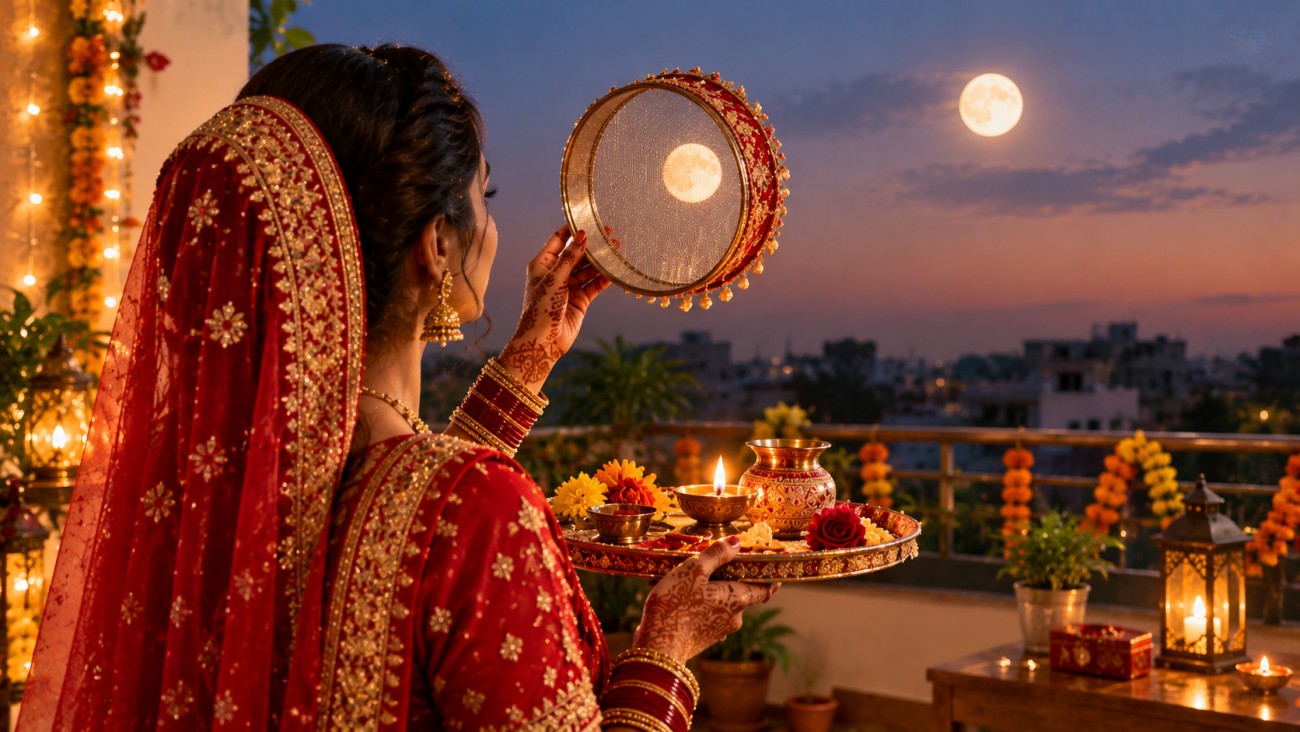
Karva Chauth is one of North India’s most recognisable festivals, celebrated through fasting, prayers, traditional attire, decorated ritual thalis and the much-awaited sight of the moon. Observed primarily by married Hindu women, the festival is traditionally associated with prayers for a husband’s health, well-being and longevity. Over time, it has also become a wider celebration of love, commitment, family relationships and togetherness.
On this special day, homes take on a festive atmosphere. Women may wake before sunrise to share a meal known as sargi, apply mehendi, dress in traditional clothing and gather with family members or friends for the evening puja. The day culminates in moon-sighting rituals, after which the fast is traditionally concluded. Although Karva Chauth is especially associated with Punjab, Haryana, Delhi, Uttar Pradesh, Rajasthan and other parts of northern India, its observance has spread to communities across India and the Indian diaspora. Families adapt the rituals according to regional customs, personal beliefs and changing lifestyles.
Table of Contents
What Is Karva Chauth?
Karva Chauth is a Hindu festival observed on the Chaturthi, or fourth lunar day, of the waning fortnight associated with the month of Kartik in the North Indian calendar tradition. It usually falls in October or November, although the Gregorian date changes every year.
INDIANFESTIVAL101 COMMUNITY
Make Every Celebration Special
Get festival inspiration, cultural stories, celebration ideas and practical guides delivered to your inbox.
By subscribing, you agree to our Privacy Policy.
Traditionally, married Hindu women observe a fast and pray for the well-being and longevity of their husbands. In many families, the day includes an evening worship ceremony, the telling or listening of the Karva Chauth story, and a ritual offering to the moon.
The name combines two words: karva, referring to a small earthen pot traditionally used in the rituals, and chauth, meaning the fourth day. The karva is an important ritual object and may be decorated with patterns, colours and festive embellishments.
Karva Chauth is particularly prominent in northern India, but no single set of customs applies to every household. Some families observe an elaborate communal ceremony, while others perform a simpler puja at home. Some couples now choose to observe the fast together as an expression of mutual care.
Why Is Karva Chauth Celebrated?
The traditional purpose of Karva Chauth is to pray for a husband’s health, long life and prosperity. For many devotees, fasting is an act of faith and personal commitment, accompanied by prayers for the well-being of the family.
The festival is also associated with stories of devotion, courage and perseverance. These narratives help explain the religious and emotional significance of the observance, although their details vary across regional and family traditions.
In contemporary life, many couples interpret Karva Chauth as an opportunity to appreciate one another and strengthen their relationship. A shared meal, a thoughtful gift, a handwritten message or simply spending time together can become part of the celebration.
It is important to recognise that customs and personal choices differ. Some women observe the traditional fast, some adapt it to their circumstances, and others do not observe it. Increasingly, some husbands fast alongside their wives. The festival can be approached with respect for tradition while recognising individual choice and well-being.
The Stories and Legends Behind Karva Chauth
Karva Chauth is associated with several traditional stories that are shared during the festival. These narratives are part of devotional and oral traditions, and versions may differ from one community to another.
The story of Veeravati
One widely known Karva Chauth story concerns a woman named Veeravati, who observes a fast for her husband’s well-being. According to a popular telling, her brothers become concerned when they see how hungry and thirsty she has become. They create the appearance of a rising moon, leading her to believe that the time has come to end her fast.
After she breaks the fast, she learns that her husband has suffered a serious misfortune. Deeply distressed, she continues her devotion and prayers. In the traditional story, her sincerity eventually leads to her husband’s restoration.
The story is often understood as a reminder of faith, patience and the importance of following the observance according to one’s tradition. Its details vary in different retellings.
The story of Karva
Another traditional narrative tells of a devoted woman named Karva whose courage and prayers protect her husband from danger. The story emphasises loyalty, determination and the power attributed to sincere devotion.
In festival storytelling, Karva’s character is remembered as an example of a wife who acts courageously when her husband needs help. Different versions of the story may emphasise different aspects of her devotion.
The story of Savitri and Satyavan
Savitri and Satyavan are celebrated in a separate but widely known Hindu narrative about a wife’s determination to save her husband. Savitri follows Yama, the deity associated with death, and uses her wisdom and resolve to secure her husband’s return to life in the story.
Although this narrative is not identical to the Karva Chauth legend, it is sometimes discussed alongside the festival because of its themes of commitment, courage and devotion.
These stories are best understood as religious and cultural narratives rather than as a single, uniform historical account. Their continuing presence demonstrates how storytelling helps families pass on values and festival customs.
When Is Karva Chauth Celebrated?
Karva Chauth generally falls in October or November, according to the Hindu lunar calendar. The observance is linked to Chaturthi during the waning phase of the moon in the relevant lunar month.
Because Hindu calendar calculations can differ according to regional conventions and the timing of lunar days, it is best to confirm the date each year using a trusted local panchang or religious calendar.
The timing of the moonrise ceremony also differs from city to city. Anyone planning the fast or evening puja should check the local moonrise time rather than relying on a schedule published for another location.
If you are planning a family gathering, arranging a festive outfit or preparing a puja thali, confirming the date early will make preparations easier.
How Is Karva Chauth Celebrated?
Karva Chauth typically unfolds through a series of rituals beginning before sunrise and ending after the moon is sighted. The precise sequence, prayers and offerings depend on the family’s tradition.
1. Sargi before sunrise
Sargi is a pre-dawn meal traditionally eaten before the fast begins. In many Punjabi families, a mother-in-law prepares or gives sargi to her daughter-in-law. Mothers and other family members may also contribute to the preparations.
A traditional sargi meal may include fruit, nuts, sweets, savoury foods, vermicelli, chapati or other household favourites. The selection differs by region and family custom.
The meal is intended to provide nourishment before the day’s fast. Those observing a fast should take account of their health and personal circumstances when deciding how to participate.
2. Fasting during the day
Traditionally, the fast continues from sunrise until the moon is sighted. Some women observe a nirjala vrat, meaning they abstain from both food and water. Others follow variations according to family customs, personal circumstances or guidance from their religious community.
The day may include prayers, time with family, preparing the puja area, applying mehendi and getting ready for the evening ceremony.
Fasting can pose health risks, particularly for people who are pregnant, breastfeeding, diabetic, unwell or taking medication that requires food or water. Religious participation should not require someone to put their health at risk. Anyone with a relevant medical concern should seek appropriate professional advice and choose a safe way to participate.
3. Getting ready in festive attire
Karva Chauth is often associated with traditional Indian clothing, jewellery, bangles, mehendi and festive makeup. Red, maroon, pink and other rich colours are popular choices, although there is no universal colour requirement.
Many women choose a saree, lehenga, salwar suit or another outfit that feels special to them. Married women may wear traditional adornments associated with their region and family.
The preparation is also social. Friends and relatives may exchange outfit ideas, help one another with mehendi or share photographs of their celebrations.
4. The evening puja
The evening puja is an important part of Karva Chauth. Women may gather at home or with relatives and neighbours to worship according to their family tradition. Goddess Parvati, Lord Shiva, Lord Ganesha and the moon may feature in the prayers, depending on the ritual followed.
A decorated karva, diya, flowers, sweets, water and other offerings may be arranged for the ceremony. The Karva Chauth story is often read or narrated, and devotional songs may accompany the gathering.
If you are preparing the ritual arrangement, our guide to pooja thali decoration offers ideas for presenting traditional items neatly and attractively.
5. Waiting for the moon
As evening approaches, many families wait for the moon to become visible. This is often the most anticipated moment of the day, especially for those observing the fast.
The wait can be a shared experience, with relatives gathering on a terrace, balcony, courtyard or another suitable place where the sky is visible. Weather and local visibility conditions can affect when the moon can be seen.
Because the timing differs by location, check a reliable local source for the expected moonrise and follow your family’s ritual guidance.
6. Moon-sighting and breaking the fast
In a widely practised version of the ritual, the woman views the moon through a sieve, offers water to the moon, and then looks at her husband through the sieve. Her husband may offer water and a bite of food to help her break the fast.
The exact sequence varies by region and household. Some families perform additional prayers or seek blessings from elders before sharing a meal.
For many couples, this moment carries the emotional significance of the festival: a day of prayer and anticipation concludes with care, companionship and food shared together.
Important Karva Chauth Traditions and Their Meaning
Karva Chauth combines ritual objects, food, clothing and storytelling in ways that reflect regional cultural practices.
The karva: The traditional earthen pot is associated with the festival’s name and is used in the ritual offering. Some families decorate the pot with paint, fabric, beads or other embellishments.
The sieve: In many traditions, a sieve is used during the moon-sighting ceremony. It is one of the festival’s most recognisable objects and is frequently seen in photographs and festive illustrations.
The diya: A small lamp provides light during the puja. Families may use a traditional oil lamp or an appropriate alternative according to their custom and safety needs.
Mehendi: Applying henna is a popular part of the celebration. Designs range from simple floral patterns to intricate bridal-inspired motifs.
Festive clothing and jewellery: Traditional attire and adornments contribute to the celebratory atmosphere. Choices vary according to family custom, region and personal preference.
Sargi and festive food: The pre-dawn meal and the meal shared after the fast are important parts of the day’s experience. The foods served depend on local cuisine and family preferences.
These traditions are meaningful because of the intentions and relationships attached to them, not because every household must follow an identical checklist.
How Karva Chauth Is Celebrated in Different Regions
Karva Chauth is most strongly associated with northern India, but its rituals vary across communities.
Punjab
In many Punjabi households, sargi is a central part of the morning preparations. Women may gather for the evening puja, listen to the Karva Chauth story and exchange ritual thalis. Traditional clothing, mehendi and family gifts also feature prominently.
Haryana and Delhi
Families in Haryana and Delhi may observe similar fasting and moon-sighting rituals, alongside local variations in the puja, food and family gatherings. Urban celebrations can include community events and organised mehendi gatherings.
Uttar Pradesh and Rajasthan
In parts of Uttar Pradesh and Rajasthan, families observe the fast with traditional prayers, decorated karvas and offerings to the moon. The details of the ritual, the story recited and the gifts exchanged can differ between communities.
Celebrations beyond India
Indian communities living abroad often continue Karva Chauth traditions in their homes or community spaces. When the festival falls on a working day, some families adapt the schedule to suit work, school and local conditions.
The central lesson is that Karva Chauth is not celebrated in exactly the same way everywhere. Respecting these differences is an important part of understanding India’s diverse festival culture.
Karva Chauth in Modern Relationships
Karva Chauth has changed in how some families interpret and celebrate it. Alongside traditional fasting and prayer, many couples now use the day to express appreciation, exchange gifts, dress up for one another or share a special meal.
Some husbands observe the fast with their wives. Other couples celebrate without fasting, choosing instead to spend time together or exchange personal messages. These practices reflect the ways traditions evolve within families and communities.
Hindi cinema, television and social media have also helped make Karva Chauth widely recognisable. Popular portrayals often highlight romantic gestures, festive clothing and the moon-sighting ritual. Real celebrations, however, are more varied than any single film or social media image can suggest.
At its best, the festival can create an opportunity for couples to talk about care, shared responsibilities and the importance of one another’s well-being. The meaning of the day is personal, and participation should be based on respect rather than pressure.
Karva Chauth Decoration Ideas for a Beautiful Celebration
A thoughtfully arranged home can make the evening puja feel festive without requiring expensive decorations.
Begin with a clean, uncluttered prayer area. Arrange the karva, puja thali, diya, flowers and other ritual items on a stable surface. A simple cloth in a festive colour can create a defined space for the ceremony.
Fresh marigolds, roses or other flowers can add colour. Small rangoli designs near the entrance or prayer area can also contribute to the atmosphere. For inspiration, explore our guide to rangoli art and its place in Indian festival culture.
Soft decorative lighting can be used around the room, but keep electrical lights and fabric away from open flames. Place diyas on stable, heat-resistant surfaces, and never leave a burning lamp unattended.
A small arrangement is often enough. The purpose is to create a peaceful and welcoming environment for prayer and togetherness, rather than to fill every corner with decoration.
Karva Chauth Gifts and Thoughtful Gestures
Gift-giving is part of many Karva Chauth celebrations, although it is not a requirement for every family. The most meaningful gift is often one that reflects the recipient’s personality, interests or needs.
Jewellery, clothing, flowers, books, skincare products and a favourite sweet are all possible choices. A handwritten note or a planned evening together can also feel special without a large budget.
For couples who want to celebrate in a more personal way, a digital greeting card can carry a message of appreciation and affection. IndianFestival101 also offers a personalised Diwali greeting card; this is designed for Diwali, but the broader idea of a personalised digital greeting can inspire other festive messages.
If giving a gift, focus on thoughtfulness rather than price. A sincere message, shared time and practical support can be as meaningful as a material present.
A Simple Karva Chauth Preparation Checklist
Preparing in advance can reduce stress on the festival day. The following checklist can be adapted to your family’s traditions.
- Confirm the festival date and local moonrise time.
- Arrange the karva, puja thali, diya and other ritual essentials.
- Plan the sargi meal, if it is part of your observance.
- Choose festive clothing and any jewellery or mehendi arrangements.
- Prepare the prayer area and keep ritual items organised.
- Confirm plans with family members or friends who will join the puja.
- Keep a suitable post-fast meal ready.
- Make health and safety a priority, and adapt the fast if necessary.
Not every family needs every item on this list. Use it as a planning aid rather than a strict set of rules.
FAQs About Karva Chauth
What is the main purpose of Karva Chauth?
Traditionally, married Hindu women observe Karva Chauth to pray for their husbands’ health, well-being and longevity. Many families also see it as a celebration of love, commitment and family relationships.
When is Karva Chauth celebrated?
Karva Chauth usually falls in October or November on the relevant Chaturthi lunar day. The date changes each year, so consult a trusted Hindu calendar or local panchang.
What is sargi?
Sargi is a pre-dawn meal traditionally eaten before the Karva Chauth fast begins. It may include fruit, nuts, sweets and other foods, with the selection varying by region and family tradition.
Why do women look at the moon through a sieve?
In a widely followed ritual, the moon is viewed through a sieve before the fast is concluded. The ceremony may also include offering water to the moon and looking at one’s husband through the sieve. Details vary between households.
What should be included in a Karva Chauth puja thali?
Depending on the family tradition, a thali may include a diya, water, a karva, flowers, sweets, rice, kumkum and other ritual items. Follow your family’s custom or local religious guidance rather than assuming every item is compulsory.
Can husbands also observe Karva Chauth?
Yes. Some couples now choose to observe the fast together as an expression of mutual care and solidarity. This is a personal and family choice, and practices vary.
Is Karva Chauth celebrated only in Punjab?
No. It is widely observed in Punjab, Haryana, Delhi, Uttar Pradesh, Rajasthan and other parts of northern India. It is also celebrated by Indian communities in many other regions and countries, with local variations.
Is fasting compulsory for everyone?
No. Observance depends on personal belief, family custom and individual circumstances. People with health concerns should not put themselves at risk to follow a fast and should seek appropriate medical guidance where needed.
What colours are traditionally worn on Karva Chauth?
Red, maroon, pink and other festive colours are popular choices, but there is no universal colour requirement. People can choose attire that suits their preferences and traditions.
How can I celebrate Karva Chauth simply at home?
You can prepare a small prayer area, arrange the ritual items used by your family, share time with loved ones and follow your chosen tradition. Simple decorations, a thoughtful message and a shared meal can make the day meaningful without elaborate arrangements.
Conclusion: Celebrating Love, Faith and Togetherness
Karva Chauth brings together prayer, storytelling, traditional adornment, family gatherings and the anticipation of moonrise. Its customs are deeply rooted in the cultural life of many northern Indian communities, yet the ways families observe the festival continue to evolve.
For some, the day is primarily a religious fast. For others, it is also an opportunity to express affection, share meaningful moments and appreciate a life partner. Regional differences and personal choices are part of the festival’s living character.
Whether you follow an elaborate ritual or celebrate in a simple way, Karva Chauth offers a moment to reflect on care, commitment and the relationships that matter. By understanding both its traditional meaning and its contemporary expressions, we can appreciate the festival as part of India’s rich and diverse cultural heritage.